There are 7 spots total for this journey ~
everyone begins with the
100 hr immersion in sept - dec, 2026
200 hr ytt goes onwards from Jan - April, 2027
————————————————————————-
~ dates / weekend content and application below ~
~ be.witnessing
sat + sun, January 9 + 10,2027
be.curious
Sat + sun, February 6 + 7,2027
be.expressive
sat + sun, March 6 + 7,2027
be.offering!
sat + sun, April 3 + 4,2027
Be.coming ~ Teaching From Within
The first 100 hours of Be.Within focused on us turning inward to experience, question, explore and better understand our beings and what we bring to our own practice.
Be.coming asks us to look outwards a bit more and how do we take what we have experienced integrate and articulate it?
How do we observe another person's body without assuming it should move like ours?
How do we choose a posture, a breath, a sequence or a modification with intention rather than simply repeating what we have been taught?
And how do we begin to sit in the seat of the teacher while remaining always, a student?
These next four months, we will revisit much of what we already know but from a different vantage point… we will “begin again” often!
We will review, weave and create.
Anatomy will inform sequencing. Philosophy will inform language. Energy systems such as the Chakras, Koshas and Vayus will move from concepts to frameworks we can draw upon. Breath will be observed and eventually guide.
A teacher can only truly teach to the depths of what they have experienced…
You will learn to “see” the unspoken language of body language and the nervous system.
over these 4 months, everyone will truly discover and strengthen their unique voice both informed by knowledge and their unique skillsets… what makes them them!
Our Weekends Will Include:
Month Five ~ Revisit • Observe • Begin
Be.Witnessing
We begin by revisiting our knowing.
After time away, we return to familiar teachings not to start over,
but because we are moving towards looking through a slightly different lens.
What changes when we move from being the person experiencing the practice to the person responsible for creating and holding the experience?
We will explore what it means to take the seat of the teacher: creating intentional space, learning to witness rather than immediately correct, and beginning to recognize the responsibility inherent in guiding another person's practice.
Our physical inquiry returns to movement, flow and why we should or should not consider sequencing certain ways. We'll explore lines of energy within asana, the role and structure of Sun Salutations, Vinyasa and Ujjayi breath, and the importance of returning to midline as movement becomes more dynamic.
We will also investigate postures sometimes labeled “risky,” asking a more useful question: Risky for whom, when, and why? Rather than creating lists of poses that are universally good or bad, we begin developing the discernment to consider
benefit, risk, intention and the individual body in front of us at that time.
Our subtle-body exploration continues its upward movement:
Anahata → Vishuddha
From heart toward expression.
Prana → Udana Vayu
From receiving toward rising and communicating.
Manomaya → Vijnanamaya Kosha
From thought toward discernment and inner wisdom.
This is where the future “guide” in us learns how to see, listen and remain curious.
Month Six ~ Explore • Discern • Adapt
Be.Curious
This month deliberately turns our perspective upside down.
We will explore inversions and the physical, emotional and perceptual changes that occur when we change our relationship with gravity. At the opposite end of the spectrum, we will spend meaningful time with Savasana and the skill involved in guiding someone toward genuine rest and integration while they are wide awake.
Our study broadens beyond individual muscles and joints to consider the body's interconnected systems and how different yoga practices may support overall function and well-being when we sequence within different “styles” for a well balanced practice.
We will explore the complementary relationship between Yin and Yang, looking at when the body may benefit from activity and challenge and when it may benefit from stillness, longer holds and less muscular effort.
Restorative + Yin Yoga introduces another question entirely:
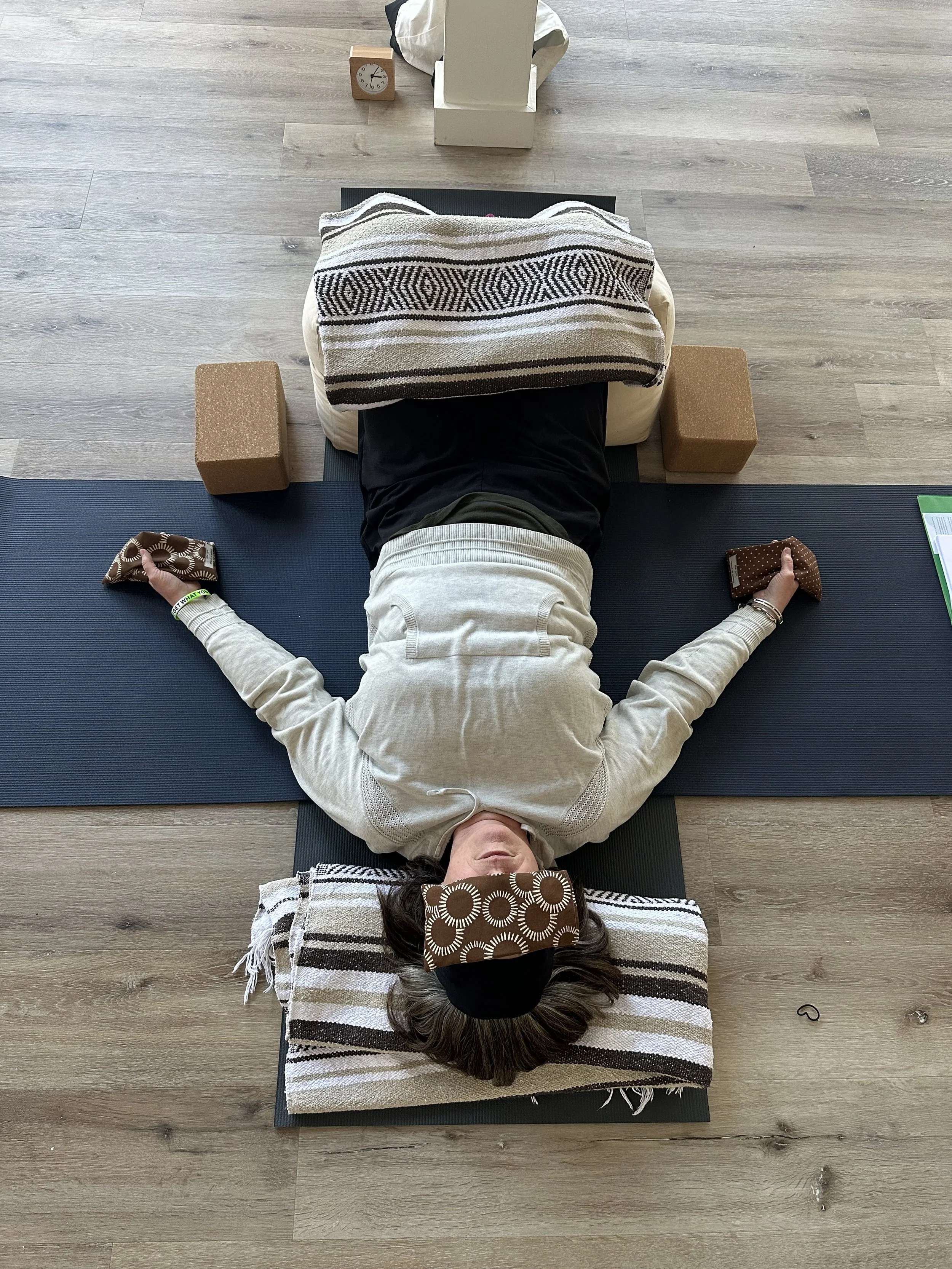
What happens when the intention isn't to strengthen or accomplish, but to support? We will explore principles of positioning, propping and timing and how these variables can greatly influence a person's experience, when these practices are appropriate and not.
This broader lens leads naturally into sequencing and class structure. Rather than learning a formula for “the perfect yoga class,” we will begin asking:
Who is in front of me?
What am I hoping this practice will offer?
Where are we beginning?
Where are we going?
And what needs to happen between those two places?
Our inquiry expands further through lifestyle, well-being and a 3 hr introduction to Ayurveda, the sister science of Yoga, offering another framework for recognizing that different people and the same person at different times may need different support.
Our subtle-body exploration continues through Ajna Chakra and Vyana Vayu, inviting broader perception, integration and the ability to see both the parts and the whole.
How many different ways could we consider ourselves to be meditating? :)
Month Seven ~ Sequence • Communicate • Create
Be.Expressive
Knowing how to speak “yoga” and communicating the essence of yoga
are very different skills.
This month is where ideas begin taking form.
We will explore the architecture of a class and how an intention can inform sequencing, how movement can prepare the body for what comes next and how breath, pacing, silence and Savasana contribute to the experience as much as the postures themselves.
We will have shared our voice in each month and now we will experiment with creating outlines through different lenses, including the Chakras, and explore how Mudra and Mantra may be incorporated with relevance and intention rather than simply added for effect.
We will also examine the environment we create before a single cue is spoken.
How do we read the room?
How do we recognize what students may need?
When do we modify?
When do we offer another possibility?
And when do we allow someone the space to discover for themselves?
We will explore modifications and considerations for common injuries and physical challenges, developing language that offers choice rather than fear.
Communication becomes a practice of its own as we refine verbal cueing, pacing, language and the balance between saying enough and saying too much.
We will also address the practical and ethical responsibilities of teaching yoga from professional boundaries and scope of practice to the realities of the business of yoga.
Our exploration of the Koshas arrives at Anandamaya, inviting us to consider what remains when doing gives way to simply being.
This month isn't about learning to sound like a yoga teacher.
It's a journey that has led to sounding uniquely like yourself!
Month Eight ~ Integrate • Create • Share
Be.Offering! Yay!
Our final month returns to the meaning at the heart of Yoga:
To yoke • To join • To connect.
The systems we have explored throughout these eight months now come back together.
Muladhara → Sahasrara
From grounding in ourselves toward recognizing our connection to something larger
Root to rise! JAI!
Apana → Vyana
Grounding, assimilating, receiving, expressing and expanding.
Annamaya → Anandamaya Kosha
From the tangible physical body through the increasingly subtle layers of our experience to the blissful knowing of ananda :)
The Eight Limbs
Not as eight separate subjects we studied, but as practices that can inform how we move, breathe, teach, relate and live.
This month is SO joyous as each person will create a final offering that reflects something meaningful from their own journey.
It might be a yoga class.
A workshop.
A meditation and breath practice experience.
An exploration of philosophy, anatomy or the subtle body.
A wellness offering.
Or something I haven't imagined yet!
The intention is not to demonstrate how much information you have memorized …
It is to ask:
What has become meaningful to me?
What do I understand more deeply now?
What might I authentically offer another person?
And then—to offer it.
We close where Yoga so often brings us:
AUM.
Beginning, Continuation, Completion and the silence that follows.
Because becoming a teacher was never meant to mark the end of being a student.
Be.Coming ~ Teaching from Within.
XO
Requirements for 200 hour Teacher Training Certification:
Be.Yoga is a Yoga Alliance Accredited School
Attend all YTT dates and times above with Kristin.
Maintain weekly journal with commitment to personal asana, meditation and inner inquiry exploration.
Successfully complete and turn in reading and written assignments.
Participate in YTT monthly sessions of various practice teaching components / asana breakdowns.
Watch anatomy videos assigned in between sessions.
Attend/ Log 25 yoga classes of your choice by end of 200 hr, At least 10 must be with Kristin.
~ Pre recorded Class Library classes are all included in training for free.Attend 2 yoga classes of your choice at another yoga studio / zoom for observation assignment.
Create and offer 3 -5 , 30-60 minute classes before graduation with 1-6 people ( family, friends, colleagues) and have feedback forms filled out by each person.
Create and share with group or community 1 Seva Yoga or Meditation class, workshop, presentation class of your choice. This will be in final month.
Payments can be made monthly or in full. All payments must be complete before the end of 100 hr : 200 hr.
200 hr Training Investment:
* 200-hour YTT: $3,550
( Includes the cost of the 100 hr Yoga Immersion, Guest teacher offerings,
Unlimited pre recorded + in person classes with Kristin,
Be.Yoga Manual + All books / materials for 100 + 200 hr )
* Non-refundable deposit of $500 is paid when application is submitted to secure your space. There are 7 spots total for this journey! *
* Monthly payment plans are available each month after the initial deposit
~ Option to pay in full after deposit is made *
Who will benefit from this experience and the nitty gritty “school”details:
Anyone interested in expanding their lenses to embrace yoga in a myriad of different ways and that is interested in doing something for themselves that is nourishing, engaging and introspective. All who are interested in possibly becoming a certified yoga teacher understanding and embracing their unique skill sets who doesn't want an immersion / training that reflects a singular philosophy/approach .
Topics covered:
Physical Anatomy
The teachings of physical anatomy will be in relationship to roughly 40 yoga postures. We will begin with the feet as our foundation and build proper alignment and posture from there. We will explore anatomy thru 3 different modes. Our own bodies, various books and teaching materials and they 3 D videos. Emphasis on modifications will be addressed in regards to staying safe through the knees, hips and shoulders and what postures pose the highest risk of injury and instability. We will also explore the relationship between each system of the body from a physical standpoint and also energetics of how each system affects us in subtle energy body. The benefits of yoga on each system in the body especially the skeletal, muscular, circulatory, endocrine, nervous and respiratory system.
Subtle Anatomy
Subtle anatomy dives into the physical body by moving from the ground up and the outside in, we will discuss the 7 Chakra energy centers, the 5 Vayus of energy movements, the 5 Kosha sheaths as well as the Bandhas. We will integrate thru the Tree of Yoga, different ways to purify and enhance the energetic qualities of each center / layer / sheath. Monthly, the chakras and meridians will be integrated and compared similarly and differently. We will look at where each energy center is located in the body, the glands affected, the energetic color, shape, corresponding element of nature, emotional and physical qualities of balance and imbalance will be explored as well as the bija sound, which we will chant. We will discus the Ida, Pingala and Shushumna Nadis in relationship to the spine and their feminine, masculine and stabilizing qualities. Kristin is passionate about the various unique and individualized ways yogis interact with stillness, movement and motion.
Yoga Philosophy
We will open this segment by considering What is Yoga? How did Yoga survive and evolve for thousands of years ago and how does it serve different ages, races and cultures now in a modern world? We will look at the Tree of Yoga and Patanjali’s 8-limb path and how it is we stand on the shoulders of the past. The importance and relevance of the Yamas and Niyamas not only in our role as teacher but also off the mat the way in which our lives are a reflection of where our energies are directed. Ethics are not just something to consider in the classroom and our group will brainstorm applying the Yamas and Yiyamas to every day life through personal journaling and dedications to the practice. We will dive into the Sutras and explore their meaning in modern world. We will discuss the interrelationship of the different paths of Bhakti, Karma, Raja and Jnana Yoga and how we can apply them in a practical matter. Each session will build upon the last as we move up thru the 8 limbs of Yoga.
Ethics & Lifestyle
We will explore what it might mean to live your yoga rather than simply on your mat, whether this be thru the lens of Seva (selfless service) or simply at the market interacting with strangers. You will have the opportunity to cultivate and oversee a personal Seva class that will be offered during the training. In regards to ethics we will discuss the importance of establishing a safe and nourishing environment for students and the ethics of relationships within the studio such as respectfully assisting and supporting a yogic environment welcoming to all individuals.
Health/Nutrition
Why do many yogis choose a certain lifestyle and diet? We will consider the importance of vibrant health and learn different tools to create that environment asking ourselves what areas of our live - past or present might challenge these ideals.. We will look thru the lens of Yoga’s sister science Ayurveda and consider raising our own vibrancy thru a myriad of options. We'll consider ways to live in harmony with the seasons and our constitutions and how we can address our own imbalances. The question we'll consider again and again is "How am I feeling? What do I need?"
Business of Yoga
The business of yoga will address different things to consider when teaching yoga in different settings and what to consider when self-employed! We will go over personal liability and insurance options and talk about different ways to market yourself personally and/or if you own a yoga studio. and the steps to run personal/professional business utilizing local media, social media, advertising, mailing lists, etc. Kristin has owned several different studios across the country and will bring her 25-yr. business background to class!
Teaching Methodology
Practical teaching methodology begins by stepping into the role of a witness, knowing we do not know what it is like to be in anyone else’s body. Being curious to better understand what yogic tools will best serve within the particular age range/experience demographics. Techniques, applications and modifications will be taught in regards to demonstrating, observing, cueing and assisting students. The importance of language both from an anatomical viewpoint and also from an energetic sense will be taught to describe moving into, aligning/modifying and maintaining the position as well as exiting postures. Discussions of methodology will explore techniques and practices to heighten insightfulness in communication and include the practices of mindfulness and being present with both individuals in a private setting and group dynamics. Differences between being a teacher rather than just an instructor will be considered. Topics will include accurate, clear verbage and different ways of observing and questioning to assimilate individuals and also the groups needs. We will look at and demonstrate the importance of how to center a group, how to create safe space for students physically and emotionally. Methodology will include the art of sequencing for vinyasa and non-vinyasa settings, how to establish a student-centered class, how to manage group dynamics, appropriate language, and the differences between verbal assists and adjustments. Kristin happily shares her 25 plus years experience and being trained in several different teaching styles. Kristin teaches Aligned and Vinyasa Flow, SATYA, Yin, Restorative, PreNatal, Energy Medicine Foundations and studied with some of Iyengars foundational instructors. We will look at each posture individually, learn how to sequence them in a Vinyasa and Non Vinyasa setting.
Practicum
In the first third of the program, trainees will be research the Sanskrit/English titles of poses, the postures alignment, physical benefits, any contraindications and important modifications and then will present to the class this research followed by sharing specific alignment of the pose. This research will then progress to include drawing with stick figures and including the Sanskrit/English names together to build to a mini-sequence reflecting an opening, a focus of mid-class theme or an ending. Eventually midway through the program the next exercise will be a Chakra class built with other members of the class. Building on this knowledge trainees will then team up with a partner to build a themed class 60 minutes long. In the last third of the course, trainees will teach a 60-minute long class open to the community with a Seva emphasis for donations.
At every point, Kristin will happily mentor any individual regarding the specific teachings they would like to focus on!
Be.Yoga Teacher Training Lead instructor -
Kristin Clark-Cork, E-RYT-500, CNT ~
Click here for Kristin's bio
Payment plan options:
100-hour training: $500 non-refundable deposit with application to hold your space & then 4 equal additional payments beginning the first month.
(A valid credit card must be provided for automatic payments along with a signed payment agreement.) You may also start making payments as soon as you enter the program. Please speak to Kristin to determine monthly amount.
200-hour training: $500 non refundable deposit with application to hold your space and then 6 equal additional payments due each month beginning the first month.(A valid credit card must be provided for automatic payments along with a signed payment agreement.) You may also start making payments as soon as you enter the program.
Cancellation policy: $500 deposit paid with application is non-refundable. If you foresee any problems completing either course please discuss with Kristin prior to your commitment. Full payment will be due once you begin the classes even if you leave the program but you are welcome to use those payments within the next calendar year.
Make up Policy:
"Life does happen," and though you have made a commitment to attend all modules of the training as listed above, emergencies and other life commitments may arise. All training hours must be made up for you to receive certification. A missed session can be made up the following ways:
You must make up the part of the session with a private session with the lead teacher ( Kristin ) at the cost of $100/hour on the scale below, that must be done before the next month's training:
1-hour private for every 1-3 hours missed.
2-hour private for every 4-7 hours missed.
3-hour private for every 8-12 hours missed.During the next YTT cycle the following year, the session that you missed can be made up at no extra charge, but your certification will be pending upon completion.
Please note: You must have 180 hours to graduate with YA certification from this training. You can miss up to 20 hours ( must be made up as listed above) during this training period. If you have questions prior to signing up for this training, please feel to contact Kristin at kristin@beyogainavon.com